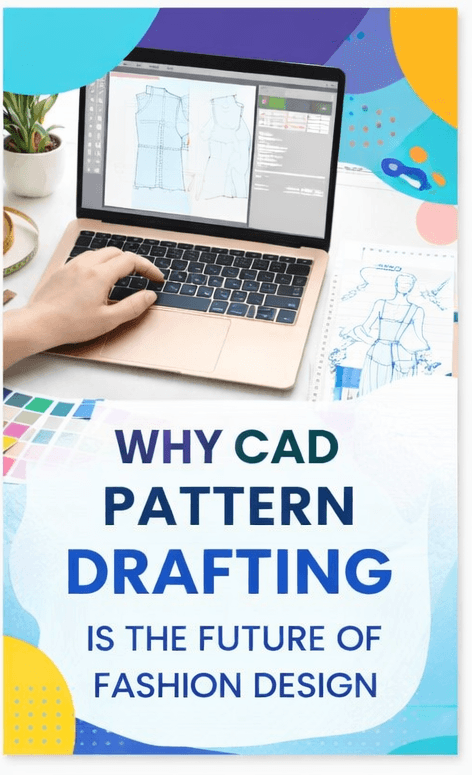
Discover why CAD pattern drafting is transforming fashion design and why every modern designer should learn digital pattern drafting skills
Learning CAD pattern drafting is the future of fashion design.
Introduction
DOWNLOAD YOUR FREE MEASUREMENT SHEETS
Have you ever stopped to think about how fashion design is quietly transforming behind the scenes?
Not on the runway.
Not in the boutiques.
But right at the designer’s desk.
OTHER RELEVANT BLOG POST



If you are someone who loves sewing, fashion design, or creating your own patterns, you may have already noticed something interesting happening in the industry.
More and more designers are moving away from traditional paper pattern drafting and stepping into the world of CAD pattern drafting.
And whatever made you click on this topic, I’m really glad you did.
Because understanding CAD pattern drafting might be one of the most important skills a modern fashion designer can learn today.
But why is this shift happening?
And what does it mean for aspiring designers like you?
Let’s explore something that many beginners are just beginning to discover.
Introduction to CAD pattern drafting
For decades, pattern drafting was done entirely by hand.
Designers used rulers, pencils, pattern paper, French curves, and endless patience to draft patterns for garments. While this method is still valuable and widely respected, the fashion industry has gradually embraced a powerful new tool.
That tool is CAD pattern drafting.
CAD stands for Computer-Aided Design, and in fashion design, it refers to the use of digital software to create precise garment patterns on a computer.
Programs like Seamly2D and other pattern drafting software have made it possible for designers to draft patterns digitally with incredible accuracy.
But this shift isn’t just about technology.
It’s about efficiency, creativity, and the future of fashion itself.
And if you’re serious about growing as a designer, understanding CAD pattern drafting is becoming less of an option and more of a necessity.
OTHER RELEVANT BLOGS



Personal Insight about CAD pattern drafting
I remember when many designers first heard about digital pattern drafting.
The reaction was often hesitation.
Some wondered:
“Can a computer really replace the traditional art of drafting patterns?”
Others felt overwhelmed by the idea of learning software.
But something fascinating happened once designers began exploring CAD pattern drafting.
They realized that CAD didn’t replace creativity.
Instead, it amplified it.
What once took hours to draft on paper could now be adjusted instantly.
Measurements could be changed in seconds.
Patterns could be reused and modified easily.
Entire collections could be organized digitally.
And suddenly, a whole new world of efficiency opened up.
The truth is, CAD pattern drafting doesn’t remove the art of fashion design — it enhances it.
What Is CAD Pattern Drafting?
At its core, CAD pattern drafting is the process of creating garment patterns using computer software rather than paper.
Instead of drawing lines manually, designers use digital tools to create pattern pieces with mathematical precision.
These digital patterns can then be
- Modified quickly
- Scaled to different sizes
- Stored digitally
- Printed when needed
One of the biggest advantages of CAD pattern drafting is parametric design.
This means patterns can adjust automatically when measurements change.
Imagine drafting a bodice pattern once and then simply updating measurements to generate a new size instantly.
That’s the power of digital drafting.
Why the Fashion Industry Is Moving Toward CAD Pattern Drafting
Fashion production is evolving rapidly.
Brands today need:
- Faster production cycles
- More accurate patterns
- Efficient collaboration
- Digital workflows
This is where CAD pattern drafting becomes essential.
With digital tools, designers can:
- Share pattern files instantly
- Make quick adjustments
- Reduce material waste
- Improve production accuracy
For fashion companies, this means saving both time and money.
For independent designers, it means working smarter.
The Growing Demand for Digital Pattern-Making Skills
LEARN CAD PATTERN DRAFTING AS A COMPLETE BEGINNER
Have you ever noticed how many industries are becoming digital?
Fashion is no exception.
Today, many fashion companies look for designers who understand CAD pattern drafting software.
These skills are valuable because digital patterns integrate easily with:
- garment manufacturing systems
- 3D clothing simulation
- automated cutting machines
In other words, designers who understand CAD drafting are better prepared for the future of fashion production.
Why CAD Pattern Drafting Is Perfect for Independent Designers
You might think CAD drafting is only for large fashion companies.
But that’s not true anymore.
Thanks to tools like Seamly2D, even independent designers and home-based creators can draft patterns digitally.
This opens amazing opportunities.
With CAD pattern drafting, you can:
- create digital patterns for sale
- start a pattern design business
- develop fashion collections faster
- organize your designs professionally
For many modern designers, digital drafting has become a creative advantage.
How CAD Pattern Drafting Improves Accuracy
Traditional drafting requires great attention to detail.
Even small mistakes can lead to fitting problems.
But with CAD pattern drafting, measurements are handled with mathematical precision.
Lines snap exactly into place.
Angles remain consistent.
Curves can be refined easily.
This level of accuracy helps designers create better-fitting garments.
Practical Steps or Strategies
If you’re curious about learning CAD pattern drafting, here are a few simple steps to get started.
Step 1: Learn the Basics of Pattern Drafting
Before diving into software, it’s important to understand basic pattern principles such as the following:
- darts
- seam allowances
- garment balance
- body measurements
These fundamentals will make digital drafting much easier.
Step 2: Choose Beginner-Friendly Software
Many beginners start with software like
These programs are designed specifically for pattern makers.
Step 3: Practice Simple Patterns First
Start with basic projects, like:
Practicing these patterns helps you understand how digital drafting works.
Step 4: Learn Measurement-Based Drafting
One of the most powerful features of CAD pattern drafting is measurement-based design.
Once you learn how to use measurement formulas, your patterns can adjust automatically for different body sizes.
Step 5: Keep Experimenting
The more you experiment with digital drafting tools, the more confident you will become.
Over time, you will discover new techniques that make pattern design faster and more creative.
6. Deeper Insight or Lesson
Here’s something interesting to reflect on.
Every generation of designers adapts to new tools.
At one time, sewing machines themselves were revolutionary.
Later came industrial cutting machines.
Today, digital tools like CAD pattern drafting software are shaping the next chapter of fashion design.
The designers who embrace these tools are not abandoning tradition.
They are expanding what is possible.
And that is what creativity has always been about.
Reflection Questions to Ask Yourself
Let me ask you a few questions to think about.
Have you ever felt frustrated drafting patterns by hand?
Have you ever wished you could modify patterns faster?
Have you ever wondered how fashion companies produce designs so efficiently?
If those questions resonate with you, then learning CAD pattern drafting might be exactly the skill that opens new possibilities for you.
Conclusion
The future of fashion design is becoming increasingly digital.
While traditional drafting will always remain an important foundation, CAD pattern drafting is clearly shaping the modern fashion workflow.
Designers who learn digital drafting gain the ability to work faster, create more accurately, and collaborate more efficiently.
And perhaps most importantly, they prepare themselves for the evolving landscape of the fashion industry.
So if you are serious about growing as a designer, this might be the perfect time to explore CAD pattern drafting.
Because the future of fashion isn’t just being sewn.
It’s also being designed on the screen.